








Introduction
There's a peculiar magic that happens when you slide behind the wheel in New Zealand. The road ahead doesn't just connect Point A to Point B—it unfurls like a living narrative, each bend revealing landscapes so cinematically perfect they seem engineered for wonder. I've driven across six continents, but nowhere else have I found myself pulling over every twenty minutes, not because something broke down, but because something broke through: another waterfall threading silver through emerald valleys, another vista that renders your carefully curated Instagram aesthetic suddenly inadequate.
New Zealand doesn't just reward the journey over the destination—it obliterates the distinction entirely. Here, the concept of "getting there" becomes almost comically irrelevant when "there" keeps shape-shifting into something even more extraordinary than what you'd originally planned. This is a country where missing your turn becomes serendipity, where running late means you're doing it right, and where the greatest travel memories emerge not from the places you meant to see, but from the moments the road itself insisted you notice.
The Geography of Astonishment
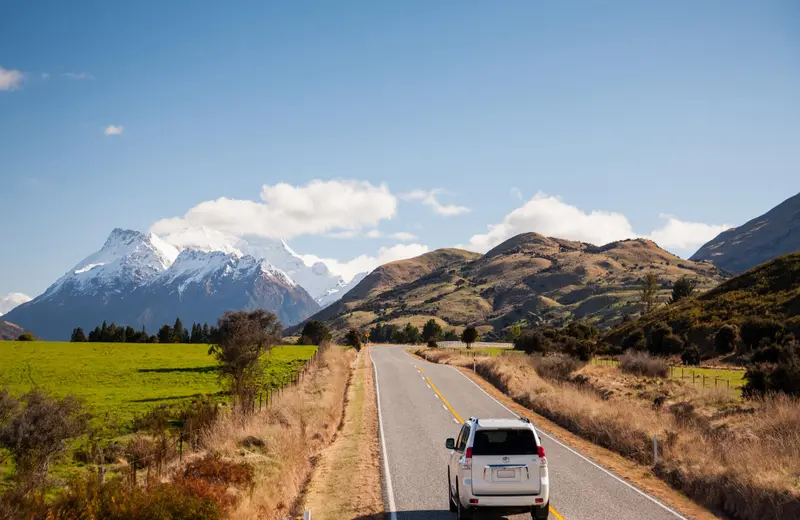
What makes New Zealand's roads uniquely captivating isn't just beauty—plenty of countries offer that. It's the relentless, almost absurd variety compressed into such a compact geography. You can breakfast beside a glacier-fed lake, lunch in wine country that rivals Tuscany, and watch the sunset from a black sand beach, all within a single day's drive. This isn't travel—it's time travel through ecosystems.
The South Island's State Highway 6, stretching 1,200 kilometers from Blenheim to Invercargill, epitomizes this geographic schizophrenia in the best possible way. Within hours, you'll transition from the Marlborough Sounds' Mediterranean-like coastline to the Southern Alps' snowcapped grandeur, then through rainforests so primordial you half-expect to see dinosaurs. The road doesn't just traverse landscapes—it collects them, like a museum curator assembling the world's greatest hits.
The North Island offers equally dramatic transformations, though with a volcanic temperament. Driving from Auckland to Wellington, you'll encounter the geothermal wonderland of Rotorua where the earth literally steams and bubbles, the otherworldly desert landscapes of Tongariro, and the rugged coastal drama of the Forgotten World Highway—which, despite its name, deserves to be unforgettably remembered.
The Art of the Scenic Detour
New Zealand's Department of Conservation has perfected something I call "strategic interruptibility"—the calculated placement of viewpoints, walking tracks, and rest areas at precisely the moments when you think you've seen it all. These aren't afterthoughts; they're invitations to deepen your relationship with the landscape.
Take the Crown Range Road between Queenstown and Wanaka. Officially, it's the highest main road in New Zealand, topping out at 1,121 meters. Practically, it's a masterclass in why altitude matters. The viewpoint at the summit doesn't just offer views—it recalibrates your understanding of scale. The patchwork valleys below, the jagged peaks piercing the sky, the quality of light at this elevation that photographers spend careers chasing—all of it accessible from a simple pull-off.
But here's where New Zealand's roads reveal their genius: the best stops aren't always marked. Some of my most treasured moments came from unofficial pull-offs—a gravel shoulder where the Matukituki River curves just so, a farm gate opening onto a track where local knowledge trumps guidebooks, a cafe in a one-building town where the proprietor's stories about the region eclipse any museum display.
The key is cultivating what I call "opportunistic alertness"—that state of readiness to abandon your schedule when something extraordinary materializes. In New Zealand, rigidity is the enemy of magic.
Milford Road: The World's Most Scenic Commute
If roads had resumes, State Highway 94—the Milford Road—would need multiple pages to list its achievements. This 120-kilometer stretch connecting Te Anau to Milford Sound has been called the finest drive on the planet, and while such superlatives usually trigger my skepticism, here they're justified.
What distinguishes the Milford Road isn't just scenery—it's storytelling. The landscape unfolds with narrative precision: the Mirror Lakes' perfect reflections, the Homer Tunnel's dark passage through solid rock (hand-carved during the Depression), the Chasm's geological violence captured in stone, and the cascading waterfalls that appear after rain like the land itself is weeping with joy.
But timing matters enormously. Drive this road in summer's middle hours, and you'll share it with tour buses and campervans in such density that the journey becomes more about traffic management than transcendence. Instead, leave Te Anau before dawn. You'll have the road largely to yourself, the light will be photographer's gold, and wildlife—kea parrots, weka birds, occasionally deer—will be out before retreating from human activity.
The return journey offers completely different perspectives. Mountains you saw backlit in morning now blaze in afternoon sun. Valleys that seemed mysterious in dawn's shadow reveal intricate detail. This is why the Milford Road rewards the round trip—it's genuinely two different experiences.
The Forgotten Highways
While everyone photographs Milford and the Great Coast Road, some of New Zealand's most character-rich driving exists on routes that tourism marketing somewhat neglects. These roads offer something increasingly rare: discovery.
The Forgotten World Highway (State Highway 43) between Stratford and Taumarunui cuts through genuinely remote country where cell service becomes theoretical and the landscape carries heavy historical weight. This was once-thriving farmland before economics and isolation forced abandonment. Now it's a 150-kilometer lesson in how nature reclaims space, punctuated by ghost towns, a tunnel that burrows through a forested hillside (bring a flashlight), and the Republic of Whangamomona—a settlement that declared independence from New Zealand in 1989 and somehow made it stick.
Similarly, the coastal route from Kaikoura to Christchurch (State Highway 1) reopened after the 2016 earthquake with sections of road literally cantilevered over the ocean. The engineering is remarkable, but what stops you repeatedly is the raw interface between land and sea—fur seal colonies lounging on rocks, sperm whales visible offshore during the right seasons, and limestone formations that look like the earth's bones breaking through skin.
The Practical Poetry of Freedom Camping
New Zealand pioneered something brilliant: the freedom camping concept that allows self-contained vehicles to park overnight in designated areas, often with million-dollar views, for free. This isn't just budget-friendly—it fundamentally changes your relationship with the landscape.
Waking to Lake Pukaki's turquoise waters with Mount Cook's reflection at dawn, having that first coffee while watching mist lift from the Moeraki Boulders, or watching stars emerge over the Dark Sky Reserve from your sleeping spot—these moments cost nothing but deliver everything.
The key is having a certified self-contained vehicle (toilets are non-negotiable in New Zealand's environmental ethic) and using resources like CamperMate or WikiCamps to find legitimate spots. New Zealand takes responsible camping seriously because its beauty is fragile. Follow the rules, and you'll discover why paying for a hotel room sometimes feels like missing the point entirely.
When Weather Becomes the Co-Pilot
New Zealand's weather deserves its own paragraph because it's less a backdrop and more an active participant in your journey. The West Coast can experience four seasons in a single drive, sunshine yielding to torrential rain yielding back to sunshine with theatrical suddenness.
Rather than fighting this variability, embrace it as texture. Some of my most memorable drives happened in conditions I'd originally considered suboptimal. The Milford Road in rain becomes a waterfall wonderland, with thousands of temporary cascades appearing on every vertical surface. The Southern Scenic Route gains mysterious drama under low clouds. Even driving through rain on the Lewis Pass has a meditative quality, the rhythm of wipers keeping time with your thoughts.
That said, winter driving requires genuine caution. Mountain passes can close suddenly. Snow chains aren't optional when signs demand them—they're the difference between adventure and emergency. Check MetService forecasts religiously, and build flexibility into your itinerary. The road will still be there tomorrow.
The Human Geography: Small Towns, Big Characters
New Zealand's small towns punch dramatically above their population weight when it comes to character. These aren't just fuel stops—they're essential chapters in understanding why driving here transcends mere transportation.
Hokitika, population 3,000, hosts the National Kiwi Centre and produces greenstone jewelry that rivals anything in larger cities. Fairlie serves pies so legendary they've achieved near-mythical status among Kiwi travelers. Glenorchy, at the head of Lake Wakatipu, offers not just stunning scenery but a community of artists, adventurers, and philosophers who chose beauty over convenience.
These towns survive because travelers pause rather than pass through. That pause—stretching your legs, chatting with locals, trying the regional specialty—adds human dimension to landscape grandeur. You realize New Zealand's magic isn't just geographic; it's cultural, woven into communities that value quality of life over scale.
Conclusion: Recalibrating Your Definition of Arrival
After thousands of kilometers on New Zealand's roads, I've arrived at a conclusion that initially seemed paradoxical but now feels perfectly logical: the best way to see New Zealand is to stop trying to see New Zealand.
Instead, let the roads guide you. Start with loose intentions rather than rigid itineraries. When something catches your peripheral vision, pull over. When locals recommend a detour, take it. When you're running late because you've stopped fourteen times in an hour, recognize this as success, not failure.
New Zealand's roads teach you that travel isn't about efficient point-to-point transit—it's about becoming so present in each unfolding moment that destinations become almost arbitrary. The journey doesn't become the destination here; it reveals that the distinction was always an illusion we created to make exploration feel manageable.
On New Zealand's roads, don't manage exploration. Surrender to it. The road knows where you need to be, even if you don't yet. And that pull-off you almost missed? That unnamed beach, that inexplicable rock formation, that cafe with the perfect flat white and even better conversation? That's not a detour from your journey.
That is your journey.
Start driving, and discover why some roads don't just take you somewhere—they take you somewhere entirely new inside yourself.