

Every traveler heading to New Zealand eventually hits the same wall. You've booked the flight, you've got the time off, and then someone asks: "So which island are you doing?" And just like that, the planning paralysis sets in. Because here's the thing — both islands are extraordinary. Both will stop you mid-breath, make you pull over the car for no reason other than to stare, and send you home a slightly different person than you arrived. But they are not the same trip. Not even close. The North Island and South Island of New Zealand are as distinct from each other as two countries sharing a ferry crossing can be. One is warm, volcanic, culturally electric, and surprisingly accessible. The other is wilder, colder, more dramatic, and almost recklessly beautiful. Choosing between them isn't about picking the better island — it's about picking the right island for you, right now. Here's everything you need to make that call.
The Landscape Difference: Volcanic Soul vs Alpine Drama
Start with the land itself, because in New Zealand, the land tells you everything.
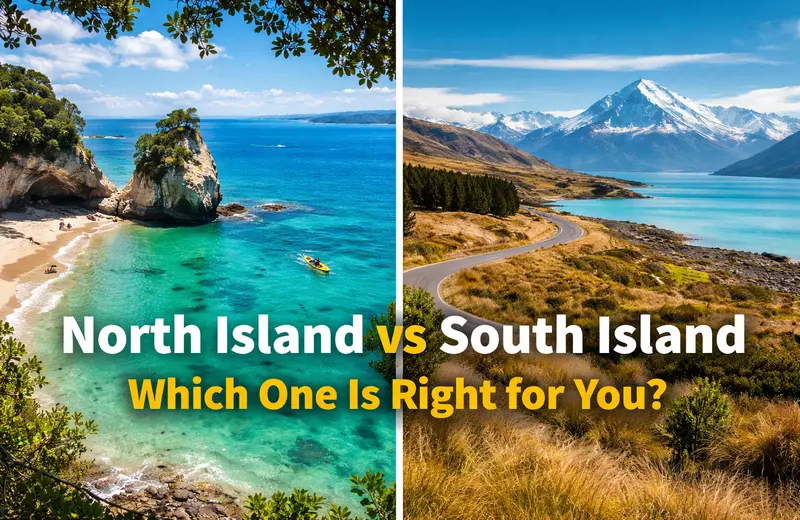
The North Island sits where the Pacific Plate slides beneath the Indo-Australian Plate — and the geological drama of that collision is visible everywhere. Steaming craters, boiling mud pools, geysers erupting on cue, volcanic lakes glowing with impossible turquoise and acid green. The three volcanoes of Tongariro National Park — Ruapehu, Tongariro, and Ngauruhoe — stand like ancient gods in the centre of the island, and the Tongariro Alpine Crossing across their flanks is widely considered one of the world's great day hikes. Beyond the volcanoes, the North Island gives you subtropical coastline in the Bay of Islands, black sand surf beaches on the west coast, rolling green farmland, and dense native forests that feel genuinely ancient.
The South Island plays an entirely different game — and it plays it at an almost unfair level. The Southern Alps run the length of the island like a spine, capped with glaciers and permanent snow. Fjords cut deep into the southwest coast, with Milford Sound and its sheer walls of rock dropping straight into still water being the most iconic. Turquoise lakes like Tekapo and Wanaka sit in glacier-carved valleys so perfectly composed they look like they've been staged. The Catlins in the far south delivers wild coastlines, sea caves, rainforest, and wildlife encounters — yellow-eyed penguins, sea lions, Hector's dolphins — in a landscape that feels like the end of the world in the best possible way.
Both islands are beautiful. But the South Island's landscapes are, for many travelers, simply more dramatic — more layered, more diverse, more relentlessly jaw-dropping per kilometer.
Culture & People: Maori Heartland vs Untouched Wilderness
Culture is where the North Island pulls decisively ahead — and it matters more than most itineraries account for.
The North Island is home to the majority of New Zealand's Maori population, and the living expression of that culture is woven into everyday life here in a way that feels genuine rather than performative. Rotorua is the spiritual heart of Maori tourism — you can experience a traditional hangi feast, watch a haka performance that genuinely moves you, visit a working marae, and learn from guides whose connection to this land goes back generations. The Waitangi Treaty Grounds in Northland, where New Zealand's founding document was signed in 1840, is the country's most important historic site. Cape Reinga at the very tip of the North Island is where Maori spirits are said to depart for their ancestral homeland — a place of quiet, significant power.
The South Island has its own Maori culture, distinct and equally rich. Pounamu — the precious greenstone found only in the South Island's rivers and mountains — has been treasured by Maori for centuries, and visiting a master pounamu carver in the South Island is a deeply meaningful experience. But the South Island is, broadly, a place where nature takes the starring role and human civilization steps respectfully to the side. You can drive for hours through the Mackenzie Basin or the Catlins without meeting another soul. That's either the appeal or the limitation, depending entirely on what you're looking for.
Adventure & Activities: Two Islands, Two Flavors of Thrill
Both islands are adventure playgrounds — but they offer completely different flavors of excitement.
The North Island is more accessible and arguably more varied in what it offers day to day. The Waitomo Caves, with their famous glowworm grottos and underground black water rafting, are unlike anything else in the country. White water rafting on the Kaituna River — home to the highest commercially rafted waterfall in the world — is extraordinary. Auckland's Harbour Bridge climb, skydiving over the Bay of Islands, surfing the black sand breaks at Raglan, and zorbing down a hillside in Rotorua all sit within easy reach of each other. The North Island is also home to most of New Zealand's geothermal spa experiences, and soaking in a natural hot pool surrounded by native bush is one of those simple pleasures that money genuinely cannot replicate.
The South Island is the undisputed home of New Zealand's most iconic bucket-list experiences. Queenstown — the self-declared adventure capital of the world — offers bungee jumping, skydiving, jet boating, skiing, and paragliding within a few square kilometers. Skiing and snowboarding across six major ski fields (including Cardrona and The Remarkables) is world-class from June through September. The South Island also features six of New Zealand's nine Great Walks, including the famous Milford Track and the Kepler Track — multi-day hikes through landscapes so extraordinary they make experienced hikers genuinely emotional. For wildlife, nowhere matches Kaikoura for whale watching, or the Otago Peninsula for seeing royal albatrosses and little blue penguins up close.
Weather & Climate: Warm & Reliable vs Wild & Unpredictable
This is one of the most practical and most underestimated differences between the two islands.
The North Island enjoys a warmer, more temperate climate year-round. In summer, temperatures in Auckland and the Bay of Islands sit comfortably between 23–28°C, and even in winter the North remains mild enough for comfortable outdoor activity. The subtropical Bay of Islands stays warm even in the cooler months, making it genuinely suitable for year-round travel. If you're visiting during a shorter window and cannot afford weather disruptions, the North Island is considerably more reliable.
The South Island is magnificent but meteorologically moody. The Southern Alps act as a massive weather wall — the West Coast receives some of the highest rainfall in the world, while the east coast basks in sunshine. Milford Sound receives an average of seven meters of rain annually, and while the waterfalls that rainfall creates are spectacular, it does affect travel plans. Weather in the mountains can shift from clear to dangerous in minutes, and serious hikers must always carry full wet weather gear regardless of the forecast. Summer (December–February) is the most reliable window for South Island travel, while the shoulder seasons of March–April and October–November offer a sweet balance of good weather and manageable crowds.
How Long Do You Have? The Time Question Changes Everything
Your available travel time is arguably the single most important factor in this decision.
If you have 7–10 days, choose the North Island. Driving distances between major highlights are shorter — most key destinations sit within 2.5 hours of each other — and you can comfortably cover Auckland, the Coromandel, Rotorua, Taupo, and Wellington without feeling rushed. The South Island simply needs more time to breathe; squeezing it into a week results in a highlights-only loop that doesn't do justice to its depth.
If you have 10–14 days, the South Island becomes genuinely viable. A focused South Island loop — Christchurch, Aoraki Mount Cook, Lake Tekapo, Wanaka, Queenstown, Milford Sound, and back — is one of the great road trips of the world and fits comfortably into a focused two weeks.
If you have three weeks or more, do both. Take the Interislander or Bluebridge ferry between Wellington and Picton — the Marlborough Sounds crossing is beautiful in itself — and treat the two islands as two distinct chapters of the same extraordinary story.
Cost: Which Island Is Easier on Your Budget?
Here's a nuance that most comparisons miss: the North Island is generally more affordable for tourists, even though the South Island is often perceived as the "main event."
Because the South Island attracts a higher volume of international visitors chasing its famous landscapes, tours and adventure activities tend to carry premium pricing. Queenstown in particular is one of New Zealand's most expensive towns — accommodation, food, and activities all reflect the demand. The North Island, by contrast, has more practical infrastructure, more freedom camping options, and slightly less inflated tourism pricing in most destinations outside of Auckland city centre.
For budget travelers, the North Island's combination of accessible freedom camping, shorter driving distances, and lower average activity costs gives it a clear financial edge. For travelers who want the bucket-list South Island experiences, the premium is worth paying — but build it into your budget honestly from the start.
The Honest Verdict: Which One Is Right for You?
Choose the North Island if: You have a week or less, you're a first-time visitor to New Zealand, you want deep Maori cultural experiences, you love geothermal landscapes, you prefer warmer weather and beach options, or you're traveling with family and need reliable, accessible itineraries.
Choose the South Island if: You have 10 days or more, you're chasing dramatic alpine scenery above all else, you want world-class hiking and adventure sports, you're happy driving longer distances between destinations, or you're returning to New Zealand and ready to go deeper.
Choose both if: You have three weeks, you've been dreaming of this trip for years, and you know in your heart that you will not forgive yourself for leaving half of it unseen.
Final Thoughts
There is no wrong answer here. Every traveler who has ever stood on a ridge in the Tongariro volcanic plateau, or watched the sun set over Milford Sound from a boat, or eaten a hangi feast under the stars in Rotorua will tell you the same thing: New Zealand gave them something they didn't know they were looking for. The North Island and the South Island are simply two different ways to receive that gift. Know what you need from this trip, trust that answer, and then go — fully, completely, without looking at your phone. The island you choose will be exactly the right one.